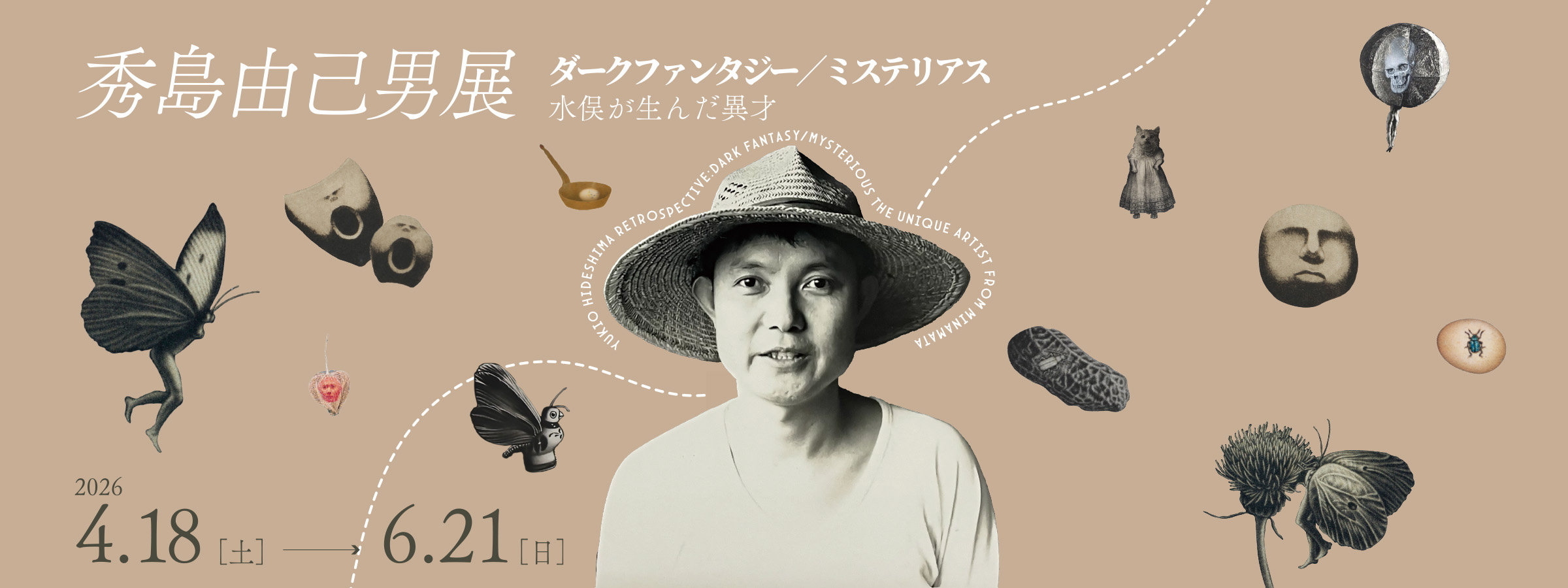
Yukio Hideshima Retrospective:
Dark Fantasy / Mysterious
The Unique Artist from Minamata
April 18 (Sat.), 2026–June 21 (Sun.), 2026
The Contemporary Art Museum, Kumamoto will hold a retrospective exhibition featuring Yukio Hideshima (1934–2018), a painter and printmaker from Minamata City who was one of the leading figures in the postwar Japanese printmaking scene. This large-scale exhibition is the first of its kind in Japan in a quarter of a century.
Largely self taught in painting, drawing, and engraving, Hideshima established himself as an artist of national standing. He earned high praise from distinguished figures such as art critic Teiichi Hijikata, painter Kinosuke Ebihara, printmaker Chimei Hamada, and poet Fukiko Yasunaga. He also created numerous illustrations for the works of writer Michiko Ishimure, with whom he maintained a close collaborative relationship. Hideshima admired the technical mastery found in Western art masterpieces, and, guided by his principle of “being original,” he devoted himself tirelessly to refining his skills—right up until his final days.
When he passed away suddenly in 2018, he left behind approximately 2,200 works, original plates, unpublished pieces including test prints, various materials, and a collection of art and craft objects amassed for his own study—all of which remained unorganized. These materials were entrusted by his bereaved family to Nagomi Town, where he spent the last years of his life. Since 2020, research of these items has been underway through collaboration between Nagomi Town and our museum.
This exhibition presents a comprehensive view of Hideshima’s artistic career from the 1950s through the 2010s, based on the results of this research. More than 260 works will be on view, drawn primarily from the Nagomi Town collection, including his major works, newly discovered materials, previously unpublished pieces, and selections from his art and craft collection.
1Beginning, Minamata
In 1934, Hideshima was born into a poor family living in the red-light district known as “Uzon no Tomo” in Minamata. Small in stature, he spent his childhood drawing alone, fishing in rivers and the sea, and playing with dolls with the neighborhood girls.
After graduating from junior high school, financial circumstances made attending high school impossible. He took jobs at a movie theater and then a rice shop, but couldn't settle in. At age 16, while unemployed, he began attending a free art class taught by art teacher Isamu Nagano, where he learned watercolor painting. Here he met writer Michiko Ishimure, whom she would come to regard as a sister for the rest of his life. Later, through Nagano's arrangement, he found employment as an administrative assistant at his old school. With the principal's permission, he began a life where he drew pen-and-ink drawings during breaks between work hours. In 1953, at age 19, he submitted Still Life to the 1st Kumamoto Prefecture Watercolor Exhibition, and was selected for the top prize.
In 1957, at the age of 23, he was introduced by Kazuyuki Sakaino, an instructor at the Second Kinosuke Ebihara Art Institute, and met copperplate engraver and sculptor Chimei Hamada, who had just returned to his hometown from Tokyo. He began studying under him. He continued to show him his framed works once a month.
In 1963, at the age of 29, he won the K Prize (The Museum of Modern Art, Kamakura Award) at the 18th Kumanichi Comprehensive Art Exhibition. The judges at the time were painter Kinosuke Ebihara and art historian-critic Teiichi Hijikata (then Director of The Museum of Modern Art, Kamakura & Hayama).
This period marks the foundation of his artistic career, yet the motifs he would pursue throughout his life—still lifes, landscapes, portraits, and figures with wide-open mouths—are already evident. Both his monochrome and color painting expressions can be seen emerging from this time.
2Spiritual, Cluster Amarylis, A Butterfly Crest
In 1964, Hideshima resigned from his position as an administrative assistant, moved from Minamata City to Kumamoto City, and began devoting himself entirely to painting. Following his receipt of the Kumanichi Prize, the highest award at the 20th Kumanichi Comprehensive Art Exhibition, he gained the patronage of Kinosuke Ebihara and Teiichi Hijikata through the arrangement of Hiroshi Matsushita from the Kumamoto Daily News Culture Department.
In 1966, at the age of 32, he debuted as a painter with his first solo exhibition, “The 1st Yukio Hideshima Solo Exhibition: Songs of Black by Pen.” Sales of his pen drawings were strong, leading to the decision to hold his solo exhibitions continuously at the same gallery, establishing him as a promising young artist.
The following year, he acquired an etching press from Chimei Hamada and began experimenting with copperplate engraving. Furthermore, from the late 1960s, he started creating still lifes and landscapes using a mixed technique combining tempera and oil paint.
The 1970s saw him collaborate with a succession of distinguished artists. He published the fairy tale book The Famous Tales of Carebaras-Country by Teiichi Hijikata, for which he provided illustrations alongside Chimei Hamada; the poetry and art book Higanbana (Cluster Amarylis) with Michiko Ishimure; and the poetry and art book Chomon (A Butterfly Crest) with poet Fukiko Yasunaga. He also held solo exhibitions.
The poetry and art book Higanbana was exhibited not only in group shows at domestic museums but also at international art fairs such as Art Basel. Hideshima also participated in group exhibitions at museums in Finland and Italy, establishing their position as one of Japan's leading artists.
His trust in Michiko Ishimure ran deep, to the extent that he illustrated her works and even asked her to name titles such as Reika (Spiritual) and Sorei-no-kuni (The Land of Ancestral Spirits). Furthermore, many of Hideshima's works were used on the cover art for Ishimure's books published in the 1970s.
3Still Life Studies
In 1984, at the age of 50, Hideshima moved to the former residence of Shuzo Takiguchi in Shinjuku, Tokyo, with the arrangement by Nantenshi Gallery.
In Tokyo, he seemed grateful for the encounters he had with leading domestic galleries of the time, such as his continuous participation in the “First Nichido Print Exhibition” hosted by Nichido Gallery, and for meeting skilled printmakers but, disliking social gatherings and, in the artist's own words, “unable to adapt to the atmosphere of Tokyo,” he returned to Kumamoto after less than three years and settled in Yamaga City starting in 1987.
One of the important projects during his time in Tokyo was the poetry and illustration book Seibutsu-kou (Still Life Studies) with poet Mutsuo Takahashi. At this period, Hideshima's still lifes reach the height of refinement.
Furthermore, in 1989, at the age of 55, he published the print book Kyu-yaku-seisho “ Shihen ” Yori (From the Old Testament “Psalms”) in memory of Teiichi Hijikata. The biblical passages featured in this collection were also selected by Mutsuo Takahashi. These very words became the titles for each of Hideshima's works.
That same year, he exhibited works alongside Chimei Hamada and others in the exhibition “広島、ヒロシマ、HIROSHIMA —The Spirit of Hiroshima as Seen by 78 Commissioned Artists from Japan and Abroad,” one of the opening commemorative exhibitions at the Hiroshima City Museum of Contemporary Art.
4What Has Come Before Us and Boat of the Wind
In 1991, at the age of 57, Hideshima accompanied a study tour organized by the Friends of the Kumamoto Prefectural Museum of Art to visit museums in the Netherlands and Belgium, experiencing his first overseas trip. This experience greatly inspired Hideshima. Later, in 1995, at his large-scale solo exhibition at the Okawa Museum of Art, he presented new works featuring landscapes such as Bruges in Belgium. Following an invitation from Mutsuo Takahashi after seeing these works, the poetry and painting book Warera-ni-sakikakete-kitari-shi-mono (What Has Come Before Us) was published.
Regarding this collection of poetry and paintings, Hideshima states he drew inspiration from Hitchcock's film The Birds. While expanding upon the imagery of death, fear, and anxiety symbolized by birds—a tradition stemming from modern Gothic novels like Edgar Allan Poe's The Raven—Hideshima's depiction of flocks of flying birds had already begun appearing in his work since the late 1980s.
During this period, Hideshima also published landscape paintings of Minamata and portraits of close acquaintances as illustrations for his serialized autobiography Kaze-no-fune (Boat of the Wind) in the Kumamoto Daily News. This endeavor would later lead to his series of illustrations for Michiko Ishimure's newspaper serial novel, Haru-no-shiro (Spring Castle).
*The Spring Castle
Michiko Ishimure's novel Haru-no-shiro (Spring Castle) (formerly titled “Anima’s Birds”) centers on the Amakusa-Shimabara Rebellion and was serialized in seven newspapers, including the Kumamoto Daily News. When Ishimure personally called Hideshima to ask him to illustrate the work, he reportedly hesitated, having heard that it would be a considerable burden for a painter. However, she persisted, and he eventually agreed.
For the project, he conducted research trips: first with a Kumamoto Daily News reporter and Ishimure, and second with just Ishimure. They visited Amakusa and the museum, taking numerous photographs for reference. One evening during their research, they were deeply moved by the mystical light shining on the sea of Amakusa. This experience became the inspiration for creating Harunoshiro ― hyōshi (Spring Castle - Cover.)
This series comprises 312 pieces in total, and there's a humorous anecdote about the portraits, for which he reportedly painted over 100 subjects. When asking friends and acquaintances to model, he would tell them, “You'll have to die for me,” and apparently chose those who didn't mind. It also features close associates who had already passed away by that time, such as Hijikata Teiichi.
From the outset of production, there was a vision to preserve at least 10-20% of the high-quality works. Consequently, seven sets of print collections, compiled from selections within this series, were published. The original artwork remained largely unpublished during the artist's lifetime.
5Positive Incompleteness and Additions
From the 2000s until his passing, Hideshima created vibrant paintings using a mixed technique involving layers of tempera and oil paint. He also produced experimental works through various methods, such as creating detailed drawings directly on color photographs, collaging photographs, and adding new elements to past works.
And during this period, according to Hideshima's words, there was a tendency to favor depicting states that expressed “not belonging to this world nor the another”—such as objects like eggs existing in a naturally transparent state—and states of change (transformation, metamorphosis).
The Utsusemi (Empty Cicada) series is a 50-piece collection brimming with color and humor, almost as a reaction to the monochrome world of Haru-no-shiro (Spring Castle). All works combine photography with drawing and collage, featuring many still lifes. Motifs like Chinese lanterns, eggs, candles, skeletons, and insects were favorites of Hideshima. Unique to this series, the artist himself appears in several works. After his battle against illness, Hideshima, now emaciated, described himself as looking “ghostly” and featured this image in works like his ghost paintings. However, the artist himself did not appear in any subsequent works.
Among the works he added to past pieces, in Takujō no shiroi seibutsu ― mō hitotsu no sekai (Table-Top White Still Life—Another World) (Unfinished), he explored the possibility of expanding his painting expression based on his worldview. He added the faces of cats and iguanas to the original still life, rendering them in a transparent and mutable state.
The works Henge ji-ttai (The Ten Forms of Transformation), Miminashihōichi ― isetsu (The Earless Hōichi: An Alternative Tale), Rokurokubi (Snake-necked woman) and Yukion'na ― shinsetsu (The Snow Woman: A New Interpretation) all center on the theme of transformation, yet they are suffused with a dark, fantastical atmosphere reminiscent of ghost stories.
Until shortly before his passing, Hideshima was working on a collaborative series with Michiko Ishimure, which remained unfinished. Though intended as small illustrations for Ishimure's poetry, all pieces experimented with the sfumato technique: depicting subjects without outlines, blurred within a green misty space.
6Behind the Scenes of His Creative Process
Hideshima passed away suddenly in 2018, leaving everything in disarray. His works and related materials were entrusted to Nagomi Town by his family. Since 2020, with the advice of our museum and through collaborative efforts with Nagomi Town, we have been conducting research on the works over a five-year period.
We discovered various materials related to the behind-the-scenes of Hideshima's creative process.
The most significant discovery was photographs. Starting in the 1970s, he began using photographs as reference material for his work. There are several photographs where Hideshima himself posed as a model, capturing a charmingly bashful expression of him around the age of 40.
Moreover, photographs capture fresh produce such as fruit, fish, and flowers, along with objects like bamboo baskets, wicker baskets, tables, and lighting fixtures used to create dramatic shadows. The backs of several prints show traces of outlines traced by holding them up to the light, indicating these were further transferred onto the original plates. Furthermore, some of the original plates, never publicly displayed during the artist's lifetime, possess a raw, visceral power surpassing that of the printed works.
The discovery that photography had been deeply involved in Hideshima's work since the mid-1970s revealed that his creation of print works—based on photogravure plates with added etching—from the 1990s, and his late-career practice since the 2000s of collaging photographs or drawing directly onto them with minute detail, represented a natural progression throughout his career.
7Interactions with Mentors and Friends—Kinosuke Ebihara, Chimei Hamada, Michiko Ishimure, Jiro Fukushima, and the Painters
As briefly mentioned in Chapter 4, since the 1990s, Hideshima has published portraits of close acquaintances as illustrations for his serialized autobiography Kaze-no-fune (Boat of the Wind) in the Kumamoto Daily News. He later created numerous portraits for the Haru-no-shiro (Spring Castle) series of illustrations accompanying Michiko Ishimure's newspaper serialized novel. In this chapter,we will introduce these portraits alongside works by each artist from the art and craft Hideshima’s collection discovered during our research.
The painter Kinosuke Ebihara was a mentor revered by Hideshima, alongside the printmaker and sculptor Chimei Hamada. The collection yielded colored pen drawings by Ebihara and two rare representative works by Hamada. Among these, Button B is an exceptionally valuable piece, having been exhibited in the “Hiroshima, Hiroshima, HIROSHIMA” exhibition, in which Hamada participated alongside Hideshima.
The artist Kazuyuki Sakaino, while serving as an instructor at the Second Ebihara Art Institute, recognized Hideshima's talent and introduced him to Chimei Hamada. A richly colored trio of small works of him was discovered from Hideshima's collection.
Michiko Ishimure, as her encounter with Hideshima had originally been at an art studio in Minamata, loved drawing. Among the collection, several pieces of colored paper were discovered where Hideshima added color to copies of Ishimure's illustrations from her final years.
Hideshima interacted widely with fellow artists of his generation in Kumamoto, but he developed a deep friendship based on mutual recognition of talent with Taeko Umemoto and Yasuko Fuchita, both students of Ebihara. Paintings and sketches by Umemoto and Fuchita were discovered in the collection. A preparatory sketch for Umemoto's large-scale painting Work II, held in our museum's collection, was also found.
A friendship also began between the Novelist Jiro Fukushima, originally from Kumamoto, and Hideshima after Fukushima received a phone call from the artist expressing admiration for his early representative work, Utsutsu-guruma(Actual Wheel). Hideshima drew creative inspiration from Fukushima's writings, while Fukushima also published the work In-getsu(Indecent Moon)which used Hideshima as a model, fostering a comfortable and unguarded relationship between them. Throughout In-getsu,Hideshima's everyday speech patterns are recorded verbatim in the text, leaving a vivid impression.
8Art and Craft Collection for Self-Improvement, Western Classical and Modern Prints, Ukiyo-e, Contemporary Artists
At his solo exhibition “GIII vol.97: Yukio Hideshima - The Living of Creation and Exploration” (2014) held at our museum, Hideshima unveiled his personal art collection for the first time. Collected for self-improvement because “studying is important,” the works he particularly treasured during his lifetime were Jacques Callot's etching The Temptation of Saint Anthony and Giovanni Battista Piranesi's etching Roman Views, 61 Sheets: The Temple of Cybele at the Mouth of Truth.
Research conducted since 2020 has uncovered several masterpieces from the collection, including one print from Goya's Los Caprichos series, Hogarth's print The Bench, and Beardsley's complete Salome series. All are worthy of a museum collection.
He also collected numerous ukiyo-e prints, though he appears to have prioritized interest in the composition and subject matter of the works over particular concerns with their printing quality or state of preservation. His interest in ukiyo-e was likely influenced by Michiko Ishimure, who in 1964 intuitively suggested commonalities between Hideshima's work and ukiyo-e.
Hideshima mentioned that his collection of contemporary artists includes works he acquired by approaching the artists himself and exchanging them for his own pieces. We heard similar accounts from the artists featured in this exhibition.
8.5Erotic’s depictions
In the art and craft collection of Hideshima introduced in Chapter 8, the works of Caro, Goya, and Beardsley, when viewed closely, reveals startlingly vivid depictions of bodily contours and gestures of flatulence.
In Hideshima's works, motifs of voluptuous breasts and buttocks, as well as the unadorned male nude, occasionally appeared as if his interest in sexuality had suddenly surfaced.
Moreover, erotic paintings (“warai-e”(laughing pictures)) from the Edo period were discovered in the collection, and two shunga works featuring cat imagery added by Hideshima were also found.
Hideshima's depictions possess little of the humorous “nonchalance” or sweetness often found in such works; instead, their raw intensity evokes tension and unease. This quality may well reflect the fruits of his diligent study from the collection.
Chapter texts are translated by Garance Bedu
Exhibition Information
Dates:
April 18 (Sat.), 2026–June 21 (Sun.), 2026
Closed:
Tuesdays (Open on May 5, but closed on May 7.)
Opening Hours:
10:00 AM – 8:00 PM (Admission until 7:30 PM)
Venue:
Contemporary Art Museum, Kumamoto (Gallery I and II)
Admission:
-
- Adult:
- ¥1,500 (¥1,300)
- Seniors (65 and over):
- ¥1,200 (¥1,000)
- Students (the high school students and over):
- ¥1,000 (¥800)
- Junior high school and under:
- Free
*The admission given in parentheses are for advance tickets / group (20 or more) / with one-day ticket for tram or buss, etc.
*Persons presenting various disability certificates (Physical Disability Certificate, Medical Rehabilitation Handbook, Mental Disability Certificate, Atomic Bomb Survivor’s Certificate, etc.) and one accompanying person are free of charge.
*Persons presenting a Welcome Passport are free of charge.
Organizer:
Yukio Hideshima Exhibition Executive Committee (Kumamoto City, Kumamoto Art and Culture Promotion Foundation, RKK Kumamoto Broadcasting Co., Ltd.), The Kumamoto Daily News
Special Support:
Nagomi Town
Grant:
-
Japan Arts Fund

Support:
Kumamoto Prefecture, Kumamoto Prefectural Board of Education, Kumamoto City Board of Education, Kumamoto Ken Bunka Kyokai (Cultural Association of Kumamoto), Kumamoto Ken Bijutsuka Renmei (Artist’s Union of Kumamoto), Kumamoto International Convention and Tourism Bureau, NHK Kumamoto Hoso Kyoku, J:COM Kumamoto, FMK, FM791